Every single day, lakhs of investors open their mutual fund app and look at one number before anything else – the NAV (Net Asset Value). It feels like the most important figure in the world. Is it up? Is it down? Should I buy more because it’s “low”?
Here’s the uncomfortable truth: the NAV is one of the most misunderstood numbers in all of personal finance. People treat it like a stock price, a discount tag, or a report card. It is none of those things.
In this article we’ll pull back the curtain on the 5 things your mutual fund’s NAV quietly doesn’t tell you – and what you should actually be looking at instead.
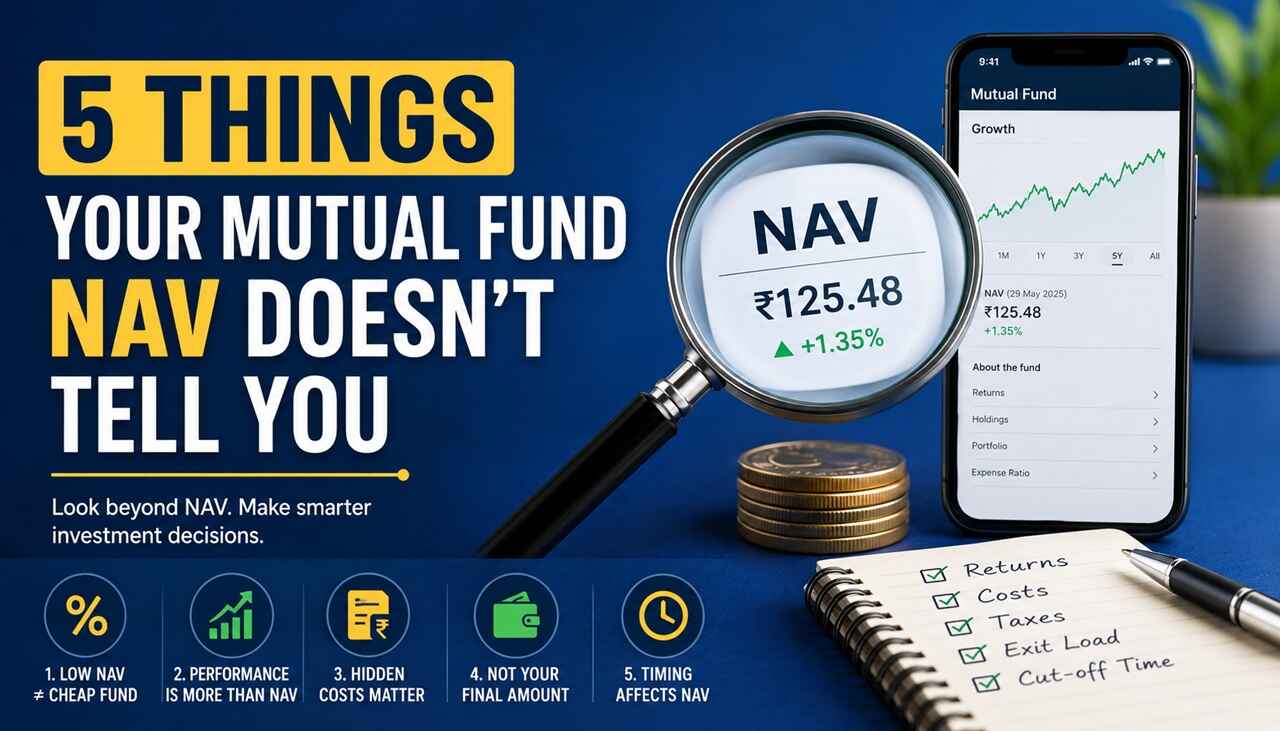
1. A “low” NAV does NOT mean the fund is cheap
This is the single biggest myth in Indian mutual fund investing, and the misconception has often been used in sales conversations to make low-NAV funds appear more attractive.
Many new investors think: “Fund A has a NAV of ₹15 and Fund B has a NAV of ₹450 – so Fund A is cheaper and I’ll get more units, so it must be the better deal.”
That logic is completely wrong. A mutual fund unit is not like a stock. The NAV level tells you nothing about whether a fund is expensive or cheap. Here’s why:
The math that proves it
| Fund A | Fund B | |
|---|---|---|
| You invest | ₹1,50,000 | ₹1,50,000 |
| NAV | ₹15 | ₹450 |
| Units you get | 10,000 | 333.33 |
| If the portfolio grows 10% | ₹1,65,000 | ₹1,65,000 |
Notice the result: both investors end up with exactly the same value. More units at a lower NAV gives you no advantage whatsoever. What matters is the percentage the fund grows, not the price tag on each unit.
A higher NAV usually just means the fund has been around longer and has compounded over time. A ₹500 NAV fund that started in 2005 isn’t “expensive” – it’s simply older and has grown.
2. The NAV tells you almost nothing about the fund’s performance
You cannot judge how good a fund is by glancing at today’s NAV. The NAV is a snapshot of value, not a measure of performance.
To actually evaluate a fund, you need to look at things the NAV will never show you on its own:
- Returns over time (CAGR): How much the fund has grown annually over 3, 5, 7 and 10 years.
- Rolling returns: A far more honest measure than point-to-point returns, because it removes the luck of a single start and end date.
- Benchmark comparison: Did the fund actually beat its benchmark index (like the Nifty 50 TRI or Nifty Midcap 150 TRI), or did it just ride a rising market?
- Consistency and downside protection: How did the fund behave during market falls, not just rallies?
3. The NAV silently hides what you’re paying every single year
Here is something most investors never realise: the NAV you see is already after costs have been deducted.
You never see the fee physically leave your account. There’s no monthly “charge” line item. The fund’s expenses are quietly adjusted into the NAV every day, which means the cost is invisible – and that’s exactly why so many investors ignore it.
That cost is the Total Expense Ratio (TER). SEBI’s 2026 Mutual Fund Regulations introduced changes to expense disclosures and fee structures aimed at greater transparency. Rather than rely on a single headline number, investors should review the latest Scheme Information Document (SID) and the scheme’s current TER disclosures for accurate expense details.
Why does this matter so much? Because a difference of even 0.10% in annual cost sounds tiny, but over a 20+ year SIP the effect of that cost compounding against you is anything but small.
4. The NAV doesn’t tell you what you’ll actually take home
Let’s say your fund’s NAV implies your investment is now worth ₹5,00,000. That is not the amount that will land in your bank account if you redeem today.
The NAV-based value shown in your account is not necessarily your final redemption proceeds. Several things sit between that number and your actual money:
- Exit load: Many funds charge an exit load (commonly around 1%) if you redeem within a certain period, often a year. The NAV doesn’t warn you about this.
- Capital gains tax: Your gains are taxable. For equity funds, short-term and long-term capital gains are taxed at different rates, with long-term gains getting an annual exemption limit before tax applies. Debt fund taxation works differently again. Tax rates and exemption limits are subject to change – investors should check the latest tax provisions. None of this is reflected in the NAV.
- Securities Transaction Tax (STT) and other small statutory charges may also apply on redemption.
So the headline value on your app is the before-deductions number. Your real, in-hand amount can be meaningfully lower, especially if you exit early.
5. The NAV you see is not always the NAV you’ll get
This is the one that genuinely surprises seasoned investors. When you place a buy order, you might assume you’ll get today’s NAV. Not necessarily.
Under SEBI’s rule effective 1 February 2021 (still in force under the 2026 Master Circular), the NAV you are allotted depends on when your money actually reaches the fund house – not just when you click “invest”. This applies to all schemes, regardless of the amount.
The cut-off times that decide your NAV:
- Equity, debt and hybrid funds: Generally, applicable NAV depends on both your application timing and your funds being realised before the prescribed cut-off time (commonly 3:00 PM on a business day). If either condition is met later, the next business day’s NAV typically applies.
- Liquid and overnight funds: The subscription cut-off is earlier, generally around 1:30 PM, with its own realisation-based rules.
This matters more than people think. If you transfer money at 2:55 PM through a slow payment mode and it only gets credited to the AMC at 4:00 PM, you’ll typically get the next day’s NAV – which could be higher or lower. Operational details can also vary slightly by transaction route or platform, so check your AMC’s or platform’s stated rules. For SIPs too, the applicable NAV now depends on when the instalment is actually realised, and using faster payment modes like UPI or net banking improves your chances of same-day NAV.
So what SHOULD you actually look at?
If the NAV isn’t the headline number it pretends to be, here’s a healthier checklist before you commit your money to any scheme:
- Rolling returns vs the benchmark – not just the flashy 1-year number.
- Expense ratio – and whether you’re in a direct or regular plan.
- Portfolio quality – what the fund actually holds, how concentrated it is, and the credit quality for debt funds.
- Risk measures – volatility and how the fund behaved in past downturns.
- Your own goal and time horizon – the most important factor of all, and one no fund metric can decide for you.
The NAV is useful for calculating how many units you hold and tracking day-to-day value. Beyond that, it’s a poor decision-making tool. Treat it as a thermometer, not a compass.
Frequently Asked Questions (FAQ)
Is a mutual fund with a lower NAV better to buy?
No. A lower NAV does not make a fund cheaper or better. You simply get more units at a lower price, and the same investment grows by the same percentage regardless of the NAV level. What matters is the fund’s quality, costs and returns – not the NAV figure.
Does NAV change every day?
Yes. Mutual funds declare their NAV once at the end of each business day, after the markets close, based on the closing value of the fund’s underlying holdings.
Why is the NAV of two good funds so different?
Age and historical performance are the primary reasons NAVs differ. A fund launched many years ago has had more time to compound, so its NAV is naturally higher, and strong long-term performance pushes it higher still. Older dividend/IDCW plans can also show a lower NAV because of past payouts. In every case, a higher NAV is not a sign of being “expensive” and a lower NAV is not a “discount”.
If I buy a fund today, will I get today’s NAV?
Only if both your application and your money are received by the fund house before the applicable cut-off time (generally 3:00 PM for equity and debt funds). If your funds are realised after the cut-off, you’ll be allotted the next business day’s NAV.
Is the expense ratio already included in the NAV?
Yes. The fund’s expenses are deducted before the NAV is declared, which is why you never see a separate fee being charged. This makes costs invisible – but they still compound against your returns over time.
Final word
The NAV is the number everyone watches and almost no one understands correctly. It won’t tell you if a fund is cheap, how well it performs, what you’re paying, what you’ll take home, or even which day’s price you’ll get. The investors who consistently do well are the ones who look past the NAV and at the things that actually drive long-term wealth.

- 20 Highest Return Mutual Funds Over the Last 20 Years - October 14, 2026
- 5 Best Value Mutual Funds for 2026 Based on Rolling Returns - October 11, 2026
- 10 Mutual Funds with Best Risk-Adjusted Returns to Invest in 2026 - October 10, 2026
Join the discussion
Add a comment ↓