
For investors building or reviewing a long-term equity portfolio, a common question is whether to invest directly in individual large cap stocks or gain exposure through an Exchange Traded Fund (ETF) linked to a broad market index.
Both approaches provide access to established large cap companies, but they differ in structure, diversification, costs, liquidity, and the level of investor involvement required. Direct stock investing relies on individual security selection, while ETFs offer diversified exposure through a market-linked structure.
For long-term investors, understanding these differences can help evaluate how each approach may fit within a broader investment strategy and risk profile.
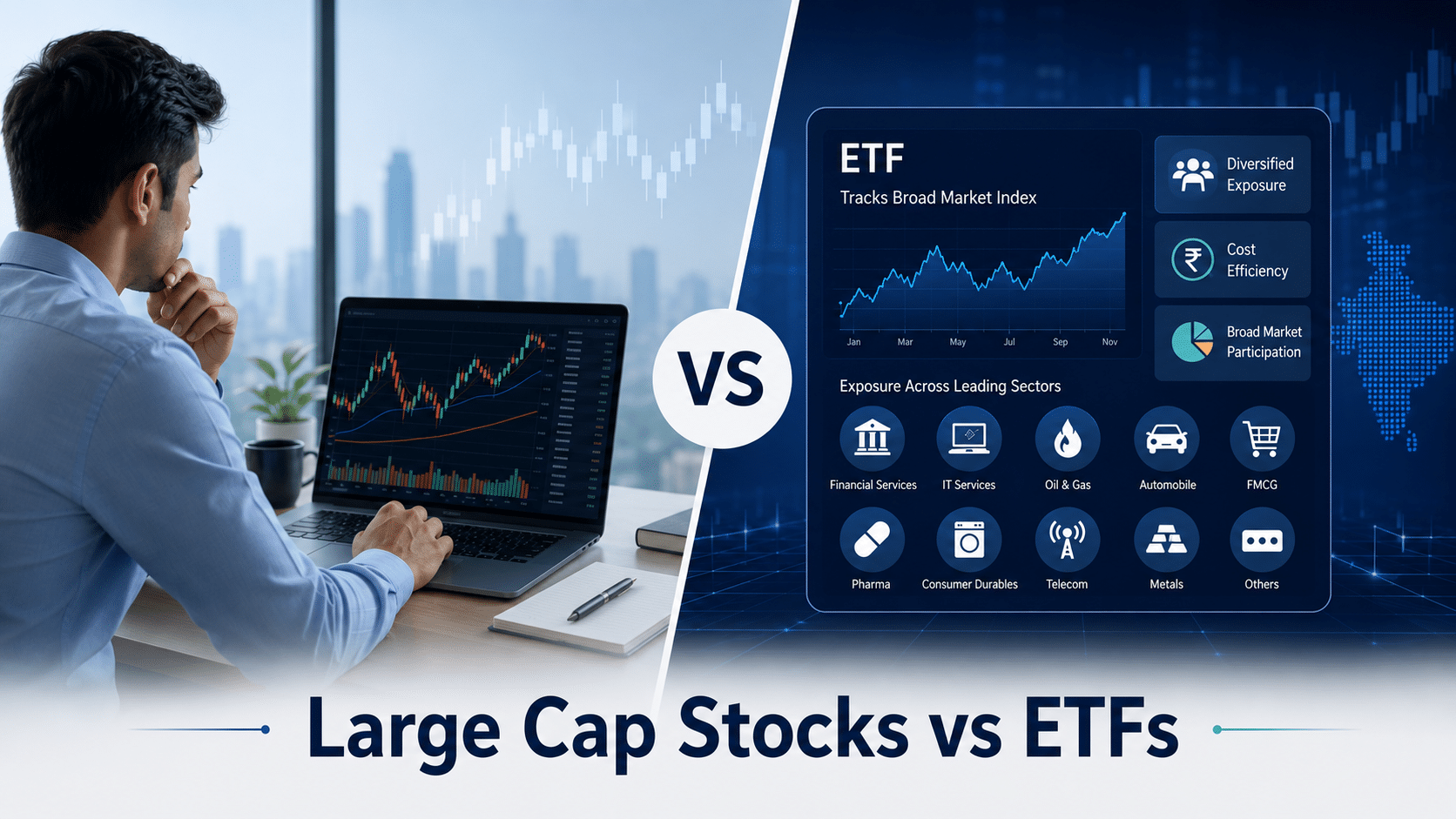
The Architecture of Ownership: Understanding Large Cap Stocks
In the Indian market, large cap companies are generally defined by the Securities and Exchange Board of India (SEBI) as the top 100 companies ranked by market capitalisation. These companies are often characterised by larger scale, broader market participation, and relatively higher liquidity compared to smaller market cap segments.
Investing directly in large cap stocks involves purchasing shares of individual companies. The investment outcome, therefore, depends significantly on the performance of the selected businesses, along with broader market conditions.
Direct ownership can provide concentrated exposure to specific companies and sectors. However, it also introduces company-specific risk, since portfolio diversification depends entirely on the investor’s stock selection and allocation decisions.
The Index Advantage: How Large Cap ETFs Work
A large cap ETF is a fund designed to track a market index such as the NIFTY50 or the SENSEX. The ETF typically holds all, or a representative sample, of the index constituents in proportions aligned with their index weights.
When investing in an ETF, investors gain exposure to the overall performance of the underlying index rather than relying on the outcome of a single company or stock selection strategy.
ETFs trade on stock exchanges throughout the trading day at market-linked prices, similar to ordinary shares. They are generally passive investment instruments, where the portfolio is managed to closely track the benchmark index rather than outperform it through active stock selection.
Large cap ETFs can provide diversified exposure across leading companies within a single investment structure. Compared with building a similar portfolio through multiple direct stock purchases, ETFs may offer operational simplicity and lower portfolio management effort for some investors.
Conviction Over Convention: The Argument for Direct Stock Selection
For investors willing to research businesses, monitor portfolios, and make independent allocation decisions, direct large cap stock investing offers a different set of characteristics compared to diversified ETF investing.
1. Potential for Superior Returns
A carefully selected portfolio of individual large cap stocks may outperform a broad market index in certain periods, particularly if the investor identifies companies with strong earnings growth, competitive positioning, or favourable valuation characteristics. However, concentrated portfolios may also underperform the broader market if stock selection decisions prove incorrect.
2. Conviction-based Concentration
Direct stock ownership allows investors to allocate more heavily towards selected companies or sectors rather than following index weights. This can increase exposure to specific investment views, but it also increases concentration risk compared to diversified index-based investing.
3. Dividend Income and Corporate Actions
Direct shareholders participate in dividends, buybacks, bonus issues, and rights offerings announced by the companies they own. These events may influence total return outcomes over time, depending on the company’s performance and capital allocation decisions.
4. No Management Fees
Direct stock ownership does not involve an annual fund expense ratio. However, investors may still incur brokerage charges, taxes, transaction costs, and portfolio management effort associated with monitoring and rebalancing holdings.
The trade-off is that direct stock investing requires time, research capability, and emotional discipline. Portfolio outcomes depend heavily on stock selection, allocation decisions, and the investor’s ability to manage concentration and behavioural risks over market cycles.
Quiet Compounders: Why Large Cap Funds Make a Formidable Long-term Case
For many investors, including first-time participants and those seeking a lower-maintenance equity allocation, large cap ETFs can provide a structured approach to broad market exposure.
1. Diversification
A single ETF investment can provide exposure to multiple large cap companies across sectors within a benchmark index. This diversification may reduce company-specific concentration risk compared to holding a small number of individual stocks directly, although sector and market risks still remain.
2. Cost Structure
Large cap ETFs generally operate with lower expense ratios than actively managed equity funds. Over long investment horizons, lower ongoing costs may positively influence net investment outcomes, although returns remain market-linked and are not guaranteed.
3. Simplicity and Accessibility
ETFs offer access to diversified market exposure through a single exchange-traded instrument. For some investors, this may reduce the operational effort associated with researching and monitoring multiple individual stocks. However, investors should still understand factors such as liquidity, tracking error, taxation, and portfolio suitability.
4. Market-linked Return Approach
Passive ETFs are designed to track benchmark indices rather than outperform them through active stock selection. While some studies suggest that many actively managed funds have struggled to consistently outperform benchmarks over extended periods after fees, outcomes can vary across timeframes and market cycles.
5. SIP-based Investing
Large cap ETFs and index-linked investment products can also be accessed through systematic investment approaches. Regular investing over time may help reduce the impact of market timing and support disciplined long-term participation in equity markets.
Beyond the Debate: Building Wealth on Your Own Terms
The comparison between direct large cap stock investing and ETF-based exposure is ultimately about investment approach, diversification preference, risk management, and the level of investor involvement desired. Both approaches provide access to established large cap companies, but they differ in concentration, portfolio construction, costs, and the role of active decision-making.
Direct stock investing may suit investors who are comfortable researching businesses and managing concentrated exposure. ETFs, meanwhile, offer diversified index-linked exposure within a single investment structure.
Online investment platforms like Jio BlackRock can help investors compare investment options, review product structures, and access market-linked investment products more efficiently. The suitability of either approach ultimately depends on an investor’s financial goals, time horizon, risk tolerance, and preferred level of portfolio involvement.

- 3 High-Risk, High-Return Indices for Mutual Fund Investors: 1, 3, 5 & 10-Year Returns - September 29, 2026
- 22 Equity Mutual Funds That Lost 10% to 24% in 1 Year – Sep 2026 Update - September 28, 2026
- 15 Mutual Funds With 10-Year Annualized Returns Above 18.1% – Sep 26 Update - September 27, 2026