
Grey Market Premium (GMP) looks exciting before listing. But does it really create long-term wealth?IPO season brings energy into the markets. WhatsApp groups light up. Telegram channels scream ‘100% listing gains’. Retail investors rush to apply when they see a high GMP number floating around. But here is the uncomfortable truth — High GMP does not automatically translate into long-term returns. In this article, let us decode why many high GMP IPOs disappoint investors after the initial euphoria fades, and when such IPOs can actually reward patient investors.
What is GMP in IPO and Why Does It Matter?
Grey Market Premium (GMP) is the unofficial premium at which IPO shares are traded before listing. If an IPO has a price band of ₹500 and the GMP is ₹200, it indicates expected listing around ₹700.
Investors often interpret high GMP as:
- Strong demand
- Oversubscription confidence
- Potential listing gains
However, GMP is sentiment-driven, unregulated, and highly speculative. It reflects short-term demand — not business quality.
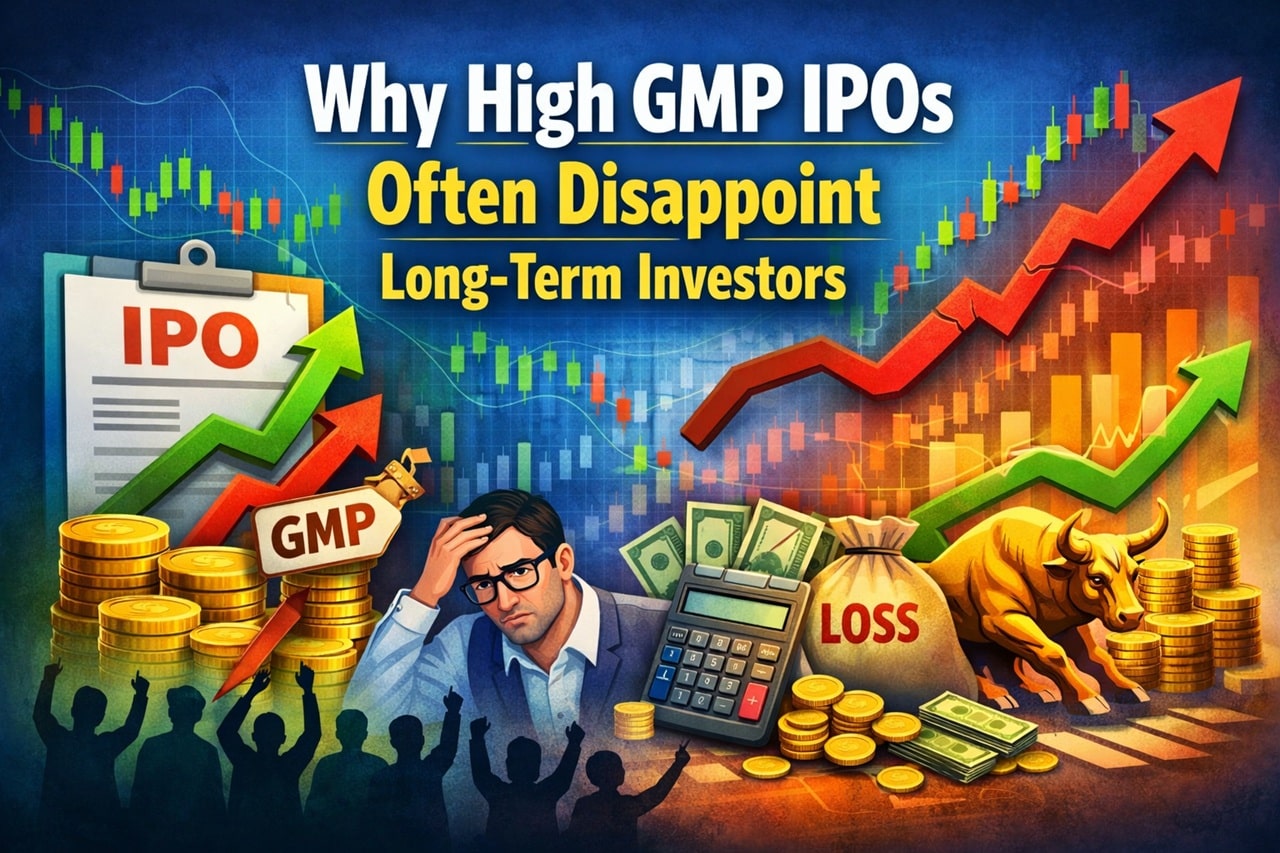
The Psychology Behind Chasing High GMP IPOs
There are three powerful forces at play:
1. Fear of Missing Out (FOMO)
When investors see headlines like “IPO subscribed 120 times”, it triggers urgency.
2. Listing Gain Obsession
Many investors apply purely for 20–40% listing gains rather than evaluating the company’s fundamentals.
3. Social Media Hype
Unverified GMP numbers circulate rapidly, amplifying expectations.
This cocktail of excitement often leads to overvaluation at listing.
Example 1: High GMP That Later Disappointed
Several IPOs in recent years listed at strong premiums but failed to sustain prices.
As an example Lenskart Solutions had high GMP, however listed at 1.5% lower than the issue price.
Another example is Zomato, it listed with 50% higher than IPO price at ₹ 116 and within 2 years the share price has fallen to below ₹ 50 within 2 years. Later over a period of next 3 years this has moved higher which is a different story.
Case Pattern (Common Scenarios)
- IPO priced aggressively
- GMP at 50–80% before listing
- Strong listing day pop
- Stock falls 40–60% within 1–2 years
Why does this happen?
- Overvaluation at IPO stage
- Profit booking by anchor investors
- Earnings failing to match expectations
- Shift in overall market sentiment
When hype cools, valuation matters.
Example 2: High GMP That Rewarded Investors
Not all high GMP IPOs fail. Some go on to become long-term wealth creators.
As an example Bharat Coking Coal had over 50% GMP and listed at 95% higher than the listed price.
Successful Pattern
- Strong industry tailwinds
- Reasonable pricing despite demand
- Consistent earnings growth post listing
- Market leadership and scalability
These companies justify their premium over time through performance — not hype.
The difference lies in fundamentals, not GMP.
The Core Problem: Confusing Demand with Value
High GMP reflects demand.
Long-term investing requires value.
If an IPO is priced at 60–80 times earnings purely because of demand, even strong growth may not justify the valuation.
Investors forget a simple rule:
Buying a great company at an expensive price can still lead to poor returns.
5 Reasons Why High GMP IPOs Often Underperform
1. Aggressive IPO Pricing
Companies often price IPOs at peak valuation cycles.
2. Private Equity / Promoter Exit
Many IPOs are Offer for Sale (OFS), where early investors exit at premium valuations.
3. Earnings Visibility Issues
If growth slows even slightly, stock prices correct sharply.
4. Post-Listing Supply Pressure
Lock-in expiry leads to additional selling pressure.
5. Broader Market Corrections
A bull market IPO listed at euphoric valuations may suffer if markets correct.
Data Insight: Listing Gains vs 3-Year Returns
Based on patterns observed in Indian IPO cycles:
- Many IPOs with 40%+ listing gains delivered muted 3-year returns.
- Some IPOs with modest or no listing gains delivered superior long-term returns.
When High GMP IPOs Actually Work
High GMP IPOs can succeed when:
- Business has scalable and predictable earnings
- Industry is structurally growing
- Valuation, though premium, is not irrational
- Company has competitive moat
In such cases, short-term excitement aligns with long-term performance.
Smart Strategy for Long-Term Investors
Instead of blindly applying for high GMP IPOs, consider this framework:
Step 1: Read the DRHP Highlights
Understand revenue growth, debt levels, and risk factors.
Step 2: Compare Valuation with Listed Peers
Is the IPO asking for unjustified premium?
Step 3: Check Offer Structure
Is it mostly fresh issue or promoter exit?
Step 4: Consider Waiting 2–3 Quarters
Post-listing results often provide clarity on execution.
Step 5: Allocate Rationally
Avoid putting large allocation purely based on GMP.
Final Verdict: Should You Avoid High GMP IPOs?
No.
But you should avoid investing because of high GMP.
GMP is a sentiment indicator — not a valuation tool.
Long-term wealth is created by:
- Strong earnings growth
- Reasonable entry valuation
- Business quality
- Time in the market
The next time you see a 70% GMP headline, pause.
Ask yourself:
“Am I investing in a business — or chasing a listing day event?”
That single question can protect your capital and improve your long-term returns.
If you found this analysis useful, consider sharing it with fellow investors who are planning to apply for upcoming IPOs.

- Why High GMP IPOs Often Disappoint Long-Term Investors - March 15, 2026
- GSP Crop Science IPO Review – Price Band, Financials, Lot Size and Should You Invest? - March 13, 2026
- Muthoot Fincorp NCD March 2026 Review – Interest Rates Up to 9.10% - March 12, 2026