
India’s infrastructure story is one of the most compelling long-term investment themes of this decade. Highways, toll roads, ports, pipelines — these are the arteries of a growing economy, and the government has been actively monetising these assets to fund new construction. It is against this backdrop that Raajmarg Infra Investment Trust (RIIT) — sponsored by none other than the National Highways Authority of India (NHAI) — is hitting the markets with a ₹6,000 crore IPO.
For most retail investors, the words “InvIT” and “infrastructure investment trust” can seem intimidating. But at its core, this is a simple concept — you are buying a share in a bundle of operational toll roads, and in return, you receive regular income distributions from the toll fees collected. Think of it like a hybrid between a fixed deposit and an equity investment — with the backing of a government body.
But should you subscribe? Is this a genuine long-term wealth-creation opportunity, or are there risks that retail investors are overlooking? In this detailed review, I break down everything you need to know — the InvIT structure, the highway assets, the financial projections, the risks, how it compares to listed peers, and my final honest recommendation.
What Is an InvIT and How Does Raajmarg Fit In?
An Infrastructure Investment Trust (InvIT) is a SEBI-regulated structure that pools money from investors and uses it to acquire, operate, and manage operational infrastructure assets — in this case, toll roads. The trust collects toll revenue from these highways and distributes at least 90% of the net distributable cash flow (NDCF) to unitholders, typically on a quarterly or half-yearly basis.
Raajmarg Infra Investment Trust (RIIT) was registered as an irrevocable trust under the Indian Trusts Act on November 24, 2025, and received its SEBI InvIT registration on December 22, 2025. It is sponsored by NHAI under the Ministry of Road Transport and Highways. The investment manager is Raajmarg Infra Investment Managers Private Limited (RIIMPL) — a collaborative venture with equity participation from leading institutions including SBI, HDFC Bank, and ICICI Bank. The trustee is IDBI Trusteeship Services Limited.
The InvIT follows the Toll-Operate-Transfer (TOT) model — NHAI transfers operational highway assets to the trust, the trust collects tolls for the concession period, and investors receive regular income from those toll collections. It is essentially government-backed infrastructure income, structured and regulated by SEBI.
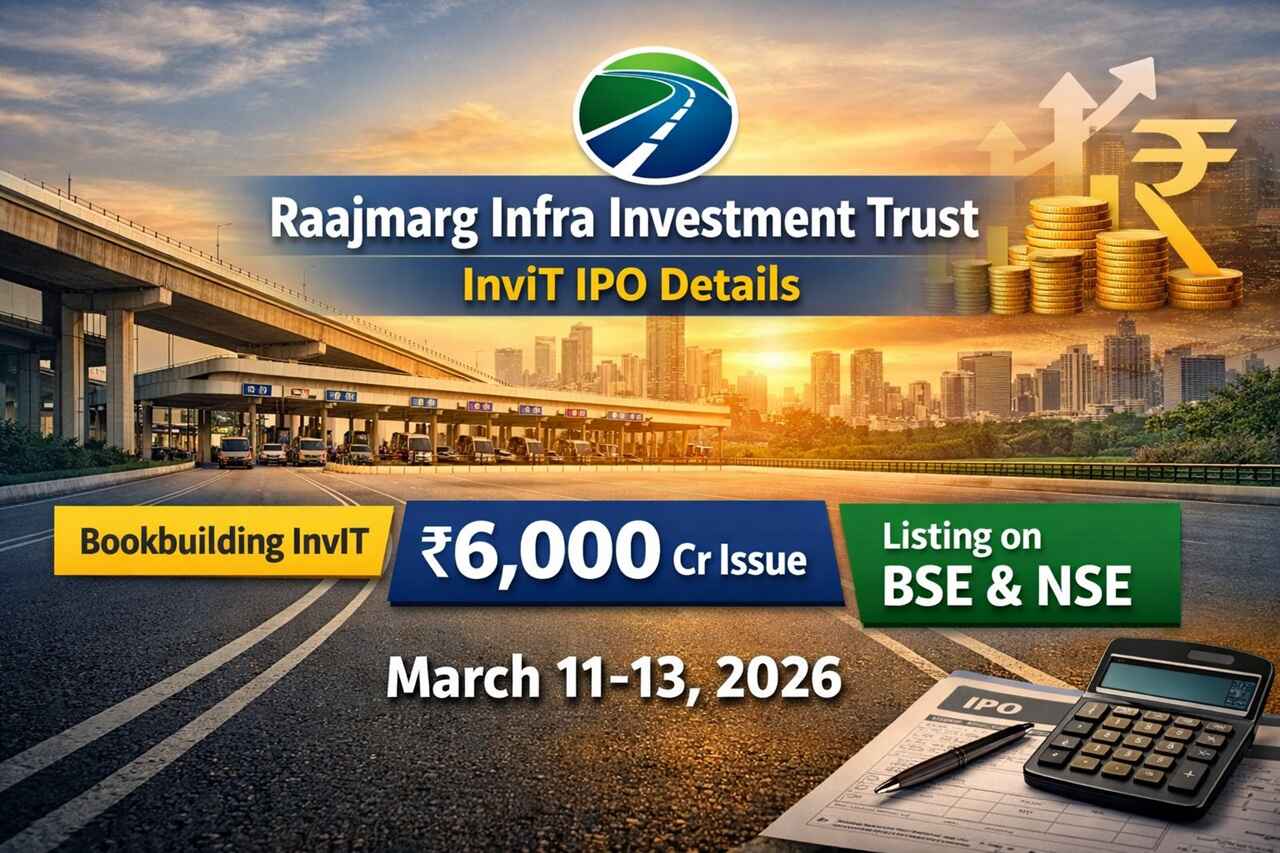
Raajmarg InvIT IPO Issue Details
| IPO Open Date | Wednesday, March 11, 2026 |
| IPO Close Date | Friday, March 13, 2026 |
| Anchor Investor Date | Monday, March 10, 2026 |
| Price Band | ₹99 to ₹100 per unit |
| Issue Size | ₹6,000 Crores (Fresh Issue only) |
| Total Units Offered | 60,00,00,000 units |
| Issue Type | Book Building InvIT |
| Face Value | To be declared |
| Listing At | BSE and NSE |
| Allotment Date | Wednesday, March 18, 2026 |
| Refund Date | Friday, March 20, 2026 |
| Credit of Units | Monday, March 23, 2026 |
| Listing Date (Tentative) | Tuesday, March 24, 2026 |
| Registrar | KFin Technologies Ltd. |
| Lead Managers | SBI Capital Markets, Axis Capital, ICICI Securities, Motilal Oswal Investment Advisors |
| Sponsor | National Highways Authority of India (NHAI) |
| Investment Manager | Raajmarg Infra Investment Managers Pvt. Ltd. (RIIMPL) |
| Trustee | IDBI Trusteeship Services Limited |
InvIT Investor Reservation
| Investor Category | Allocation |
| QIB (Qualified Institutional Buyers) | Not more than 75% of Net Issue |
| NII (Non-Institutional Investors / HNIs) | Not less than 25% of Net Issue |
| Retail Investors | 0% — Not available for retail |
Important Note: This InvIT has ZERO retail quota. Unlike a regular IPO, retail investors cannot apply through the standard retail category. Individual investors can apply only under the NII (HNI) category with a minimum application size. This is a key differentiator from a regular equity IPO and readers must understand this before applying.
About Raajmarg Infra Investment Trust — The Highway Portfolio
The trust’s initial portfolio comprises five operational toll road assets developed under NHAI’s Toll-Operate-Transfer (TOT) model, spanning a combined length of approximately 260.198 km across four states — Jharkhand, Andhra Pradesh, Tamil Nadu, and Karnataka. All five assets form part of the Golden Quadrilateral network, India’s most critical road infrastructure connecting the country’s four metro cities.
| Highway Stretch | State | Network | Traffic Type |
| Gorhar – Barwa Adda | Jharkhand | GQ | ~12,500 AADT |
| Chilakaluripet – Vijayawada | Andhra Pradesh | GQ | ~37,725 AADT |
| Chennai Bypass | Tamil Nadu | GQ / Intra-city | High freight |
| Chennai – Tada | Tamil Nadu | GQ | Port linked |
| Nelamangala – Tumkur | Karnataka | GQ / Intra-city | Freight & commuter |
GQ = Golden Quadrilateral National Highway Network. AADT = Average Annual Daily Traffic (FY26 base year).
Revenue and EBITDA Projections
Since this is a newly formed trust with no operating history, there are no restated historical financials available in the traditional sense. However, the RHP includes a detailed valuation report with revenue and EBITDA projections for the five assets based on historical toll data and traffic growth estimates.
| Particulars | FY2026-27 (Base Year) | FY2040-41 (Terminal Year) |
| Projected Revenue | ₹925.8 Crore | ₹2,738.7 Crore |
| Projected EBITDA | ₹876.6 Crore | ₹2,442.1 Crore |
| Revenue CAGR | — | ~8.1% per annum |
| Portfolio Valuation | ₹9,500 Crore | — |
| Enterprise Value | ~₹9,800 Crore | — |
| Toll Revision Mechanism | 3% fixed + 40% WPI indexation | Inflation-linked |
| Concession Period | 15 years from appointed date | NHAI-backed |
The revenue CAGR of 8.1% is supported by India’s consistently growing vehicle population, the expansion of freight movement on national corridors, and the built-in inflation-linked toll revision mechanism — which means toll rates automatically increase with WPI (Wholesale Price Index). This provides a natural hedge against inflation for investors.
Objects of the Issue
| Purpose | Estimated Amount (₹ Cr.) |
| Infusion of debt and equity into Project SPV for payment of concession value of InvIT Assets to NHAI | ₹5,850 Crore |
| General corporate purposes | Balance of proceeds |
| Total | ₹6,000 Crore |
The primary use of funds is entirely for acquiring the toll road assets from NHAI. This is a pure asset acquisition play — there is no dilution to existing promoters, no OFS component, and no funds going toward general corporate expenses beyond a small portion. The entire capital raised goes into creating the income-generating asset base that will drive distributions to investors.
Competitive Strengths
1. Sovereign-Grade Sponsor — NHAI
This is the single biggest differentiator of this InvIT. NHAI is a statutory authority of the Government of India with an exceptional 25+ year track record in building, operating, and maintaining India’s national highway network. As sponsor, NHAI provides RIIT with institutional credibility, low counterparty risk, and access to a massive pipeline of future assets. There is no private sector credit risk involved.
2. Right of First Offer (ROFO) — 1,500 km Pipeline
NHAI has provided RIIT with a Right of First Offer (ROFO) on approximately 1,500 km of additional highway assets over the next 3-5 years. This is the growth engine of the trust. As AUM grows, distributions per unit can increase and the overall InvIT becomes more valuable. This defined pipeline eliminates the uncertainty typical of corporate growth stories — investors can see exactly where future cash flows will come from.
3. Strategic Assets on Key Economic Corridors
All five highways are part of the Golden Quadrilateral — India’s most trafficked highway network connecting Delhi, Mumbai, Chennai, and Kolkata. The Chilakaluripet-Vijayawada stretch carries nearly 37,725 vehicles per day, while the Chennai Bypass and Chennai-Tada routes carry port-linked freight traffic, which tends to be highly resilient even during economic slowdowns.
4. Inflation-Protected Revenue Mechanism
Toll rates are revised annually through a dual mechanism: 3% fixed increase plus 40% of the Wholesale Price Index (WPI) change. This means as inflation rises, toll revenues rise proportionately. For income-seeking investors, this is a genuine inflation hedge — unlike fixed deposits or bonds which lose real value when inflation picks up.
5. Regulated SEBI Structure with Mandatory 90% Distribution
Under SEBI’s InvIT regulations, RIIT is mandatorily required to distribute at least 90% of its net distributable cash flows to unitholders. This is a legal requirement, not a management discretion. Combined with quarterly reporting and SEBI oversight, investors have far more transparency and income predictability compared to a regular equity investment.
6. Experienced Management Team
The investment manager RIIMPL is backed by equity participation from SBI, HDFC Bank, ICICI Bank, and other leading financial institutions. The management team brings over 20 years of experience in roads and highways sector operations, maintenance, and compliance.
Risk Factors — Deep Dive Analysis
1. No Operating History — Zero Track Record
This is the most critical risk for any investor to understand. RIIT was registered only in December 2025 and has no operating history whatsoever. The projections in the RHP are based on the historical performance of the underlying assets, but the trust itself has never collected a single rupee in toll revenue, made a single distribution, or filed a single quarterly report. The trust has also not yet executed binding concession agreements or facility agreements as of the filing date. Investors are essentially betting on future performance.
2. Retail Investors Excluded — NII Category Minimum
Unlike a regular IPO, this InvIT has zero retail allocation. The 25% NII quota typically requires a minimum application that is significantly larger than a retail investor’s budget. This effectively means this is an instrument for HNIs, institutions, and well-capitalised investors — not for small retail investors looking to invest ₹10,000–₹15,000.
3. Dependence on Toll Traffic Volumes
Revenue is entirely dependent on traffic volumes. Any economic slowdown, increase in fuel prices, development of alternative routes, or disruption in freight movement will directly impact toll collections. Unlike an annuity InvIT (like Bharat Highways InvIT), there is no government-guaranteed minimum payment — income is directly tied to how many vehicles use these roads.
4. IRB InvIT — A Cautionary Tale
It is important to mention here that not all highway InvITs have delivered well for investors. IRB InvIT, India’s first listed highway InvIT, has lost over 32% of its value from listing price and trades at a significant discount to its Net Asset Value. This is a reminder that InvIT investments carry real capital risk, especially for secondary market investors who may buy after listing at a premium.
5. Regulatory and Policy Risk
The InvIT framework in India is still relatively new and evolving. Regulatory changes by SEBI or the Ministry of Road Transport — such as changes to toll revision formulas, concession terms, or mandatory distribution requirements — could materially impact returns. Investors must be comfortable with this regulatory uncertainty.
6. Concession Agreements Not Yet Executed
As highlighted in the risk factors of the RHP, the trust has not yet executed binding concession agreements for the InvIT assets as of the filing date. The completion of this InvIT is contingent on these agreements being executed successfully. Any delay or complication in the concession transfer process could impact timelines.
7. Interest Rate Sensitivity
InvITs are yield instruments and are therefore sensitive to interest rate movements. When interest rates rise (as in an RBI rate hike cycle), the yield offered by InvITs becomes less attractive compared to bonds and FDs, which typically causes InvIT unit prices to fall. Conversely, in a rate-cut environment, InvITs tend to perform well.
Grey Market Premium (GMP)
As of the date of writing this article, the grey market premium (GMP) for Raajmarg InvIT is at ₹0 — no grey market trading has commenced yet given the InvIT opens on March 11, 2026. Unlike regular SME or mainboard equity IPOs where grey market activity begins days before opening, InvITs typically see limited grey market interest due to the institutional nature of the investor base and the absence of retail allocation.
Peer Comparison — Listed Road InvITs in India
| InvIT | Sponsor Type | Model | Track Record | Performance |
| Raajmarg InvIT (RIIT) | NHAI (Govt.) | TOT (Toll) | None — New | Yet to list |
| NHIT (Private InvIT) | NHAI (Govt.) | TOT (Toll) | 3+ years | NAV ~₹131-155 |
| Bharat Highways InvIT | GR Infra (Private) | HAM (Annuity) | ~2 years | Moderate |
| IRB InvIT | IRB Infra (Private) | BOT/TOT/HAM | 6+ years | -32% from listing |
The closest and most relevant comparable for RIIT is NHIT (National Highways Infra Trust) — also NHAI-sponsored, also TOT model. NHIT’s NAV has grown from listing to approximately ₹131-155 range with regular income distributions, demonstrating the model works when backed by quality assets and a credible sponsor. RIIT is essentially the public-market version of NHIT, which has so far been accessible only to large institutional investors.
How to Apply for Raajmarg InvIT IPO?
Since there is no retail quota, retail investors technically cannot apply. However, individual investors with higher capital can apply under the NII (HNI) category:
- Open a Demat account with any registered broker (Zerodha, Groww, HDFC Securities, ICICI Direct, etc.)
- Log into the broker’s platform and go to the Current IPOs section
- Search for ‘Raajmarg Infra Investment Trust’
- Select the NII category and enter the application amount
- Approve the UPI mandate or use ASBA through your bank’s net banking
- Application must be submitted between March 11–13, 2026
- Allotment will be on March 18, 2026; listing on March 24, 2026
You can also apply directly through ASBA (Application Supported by Blocked Amount) via your bank’s net banking portal — all major banks including SBI, HDFC, ICICI, and Axis support this.
Should You Subscribe or Avoid?
For Long-Term Income-Seeking Investors
If you are looking for a long-term, inflation-protected income instrument backed by a government entity, Raajmarg InvIT deserves serious consideration. The NHAI sponsorship is the most credible possible backing in India’s infrastructure space. The 8.1% projected revenue CAGR, inflation-linked toll revisions, and a 1,500 km pipeline of future assets create a compelling structural story.
The best comparable — NHIT — has shown that the NHAI-backed TOT InvIT model works. If RIIT executes its asset acquisition and concession agreements as planned, there is a reasonable basis to expect regular quarterly distributions and potential NAV appreciation over a 5-7 year horizon.
For Short-Term / Listing Gain Investors
This is not the instrument for you. With zero retail allocation, a complex InvIT structure, and no grey market premium to reference, listing gains are highly uncertain. The primary market for this InvIT is institutional — pension funds, insurance companies, and large HNIs. Retail or small investors chasing listing gains should stay away.
Key Concerns That Make Me Cautious
- Zero operating history — the trust has never actually operated these assets yet
- Concession agreements and facility agreements have not yet been executed as of the RHP filing
- IRB InvIT’s poor performance is a real reminder that highway InvITs can underperform
- No retail allocation means limited secondary market liquidity post-listing
- Interest rate risk — if RBI raises rates, InvIT yields become less attractive
Final Verdict
Neutral to Cautiously Positive for Long-Term for HNI / Institutional Investors. The NHAI sponsorship, Golden Quadrilateral asset quality, inflation-linked revenues, and a defined 1,500 km growth pipeline make this a structurally sound long-term income vehicle. However, the complete absence of operating history, the yet-to-be-executed concession agreements, and the zero retail quota are concerns that cannot be ignored.
High risk investors with surplus capital, a long-term income orientation, and the ability to invest at NII-level ticket sizes may consider a moderate allocation. Conservative/moderate risk should wait and observe the trust’s first 2-4 quarters of actual distributions before making a decision in the secondary market.
Do not invest solely based on the NHAI name. Read the RHP carefully, understand the InvIT structure, and invest only within your risk appetite and time horizon.
Frequently Asked Questions (FAQs)
1. What is the Raajmarg InvIT IPO date?
The InvIT opens for subscription on March 11, 2026 and closes on March 13, 2026. Anchor investor bidding is on March 10, 2026.
2. What is the price band?
The price band is set at ₹99 to ₹100 per unit.
3. Can retail investors apply?
No. This InvIT has zero retail quota. Individual investors can only apply under the NII (HNI) category, which requires a significantly larger investment than a typical retail IPO application.
4. What is the issue size?
The total issue size is ₹6,000 crore — entirely a fresh issue of 60 crore units. There is no Offer for Sale (OFS) component.
5. When is the listing date?
The tentative listing date is Tuesday, March 24, 2026 on both BSE and NSE.
6. Who is the sponsor of this InvIT?
National Highways Authority of India (NHAI), a statutory authority under the Ministry of Road Transport and Highways, Government of India.
7. What returns can investors expect?
The RHP projects revenue CAGR of 8.1% from FY27 to FY41. As InvITs must distribute at least 90% of NDCF, investors can expect regular income distributions — the actual yield will depend on the final unit price and distributions declared after operations commence. Comparable NHAI-backed InvITs have historically delivered 8-10% distribution yields.
8. Is this InvIT good or bad for investment?
Cautiously positive for long-term HNI investors seeking income from NHAI-backed infrastructure. Not suitable for retail investors, short-term traders, or investors seeking listing gains. Read the full analysis above for a complete picture.
Disclaimer: This article is for informational and educational purposes only and does not constitute investment advice. Mutual Fund and InvIT investments are subject to market risks. Please read all scheme-related documents including the Red Herring Prospectus (RHP) carefully before investing. Consult a SEBI-registered financial advisor before making any investment decisions. The views expressed here are based on publicly available information and personal analysis.

- Capri Global Capital NCD – April 2026 – Issue Details, Interest Rates, Ratings and Review - April 1, 2026
- Protecting Your Pockets – How Comprehensive Plans Cover More Than Just Basic Repairs? - March 31, 2026
- Best SIP Mutual Funds for ₹ 5,000 Monthly Investment in 2026 (Top 5 Funds) - March 29, 2026