
Many investors face a common dilemma: Should you invest in high return mutual funds to build wealth faster, or choose low risk mutual funds to protect capital? This question becomes even more important in volatile markets where returns can fluctuate significantly. In this article, we will compare high return vs low risk mutual funds, understand who should invest in them, and provide a simple framework to decide what works best for you.
Check out our earlier article on 10 High Return Mutual Funds with 50% to 187% returns in the last 1 year.
As per Morningstar’s risk‑return framework, investors should evaluate mutual funds not just based on returns but also on volatility and downside risk. Funds are broadly categorized from low risk to high risk depending on variations in returns, helping investors align investments with their risk tolerance. This is why choosing between high return and low risk mutual funds should be based on your financial goals and ability to handle market fluctuations.
What are High Return Mutual Funds?
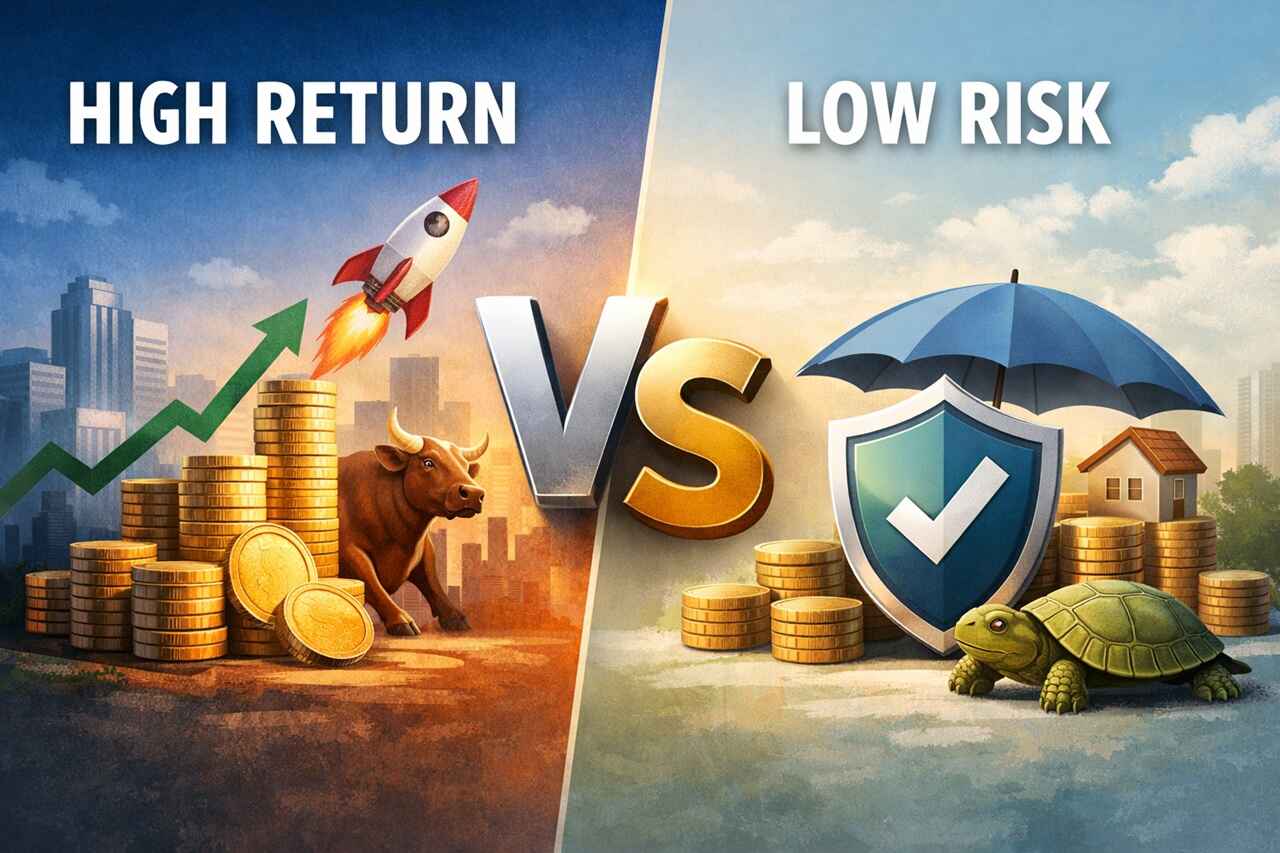
High return mutual funds are schemes that aim to generate superior long-term returns by investing in equities or high-growth opportunities. These funds typically come with higher volatility but have the potential to create significant wealth over time.
Key Features of High Return Mutual Funds
- Invest predominantly in equities
- Higher volatility in the short term
- Suitable for long-term wealth creation
- Returns fluctuate with market cycles
- Ideal for aggressive investors
Examples of High Return Mutual Fund Categories
- Small Cap Mutual Funds
- Mid Cap Mutual Funds
- Flexi Cap Mutual Funds
- Sectoral / Thematic Funds
What are Low Risk Mutual Funds?
Low risk mutual funds focus on capital protection and stable returns. These funds invest in debt instruments, high-quality bonds, or a mix of equity and debt to reduce volatility.
These are suitable for conservative investors who want predictable returns with lower risk.
Key Features of Low Risk Mutual Funds
- Invest in debt or hybrid instruments
- Lower volatility
- Stable but moderate returns
- Suitable for short to medium term
- Ideal for conservative investors
Examples of Low Risk Mutual Fund Categories
- Liquid Funds
- Ultra Short Duration Funds
- Corporate Bond Funds
- Balanced Advantage Funds
- Conservative Hybrid Funds
However, ValueReseach categorises several equity funds also as Low risk funds.
High Return vs Low Risk Mutual Funds – Key Differences
| Feature | High Return Mutual Funds | Low Risk Mutual Funds |
|---|---|---|
| Risk Level | High | Low to Moderate |
| Return Potential | High | Moderate |
| Volatility | High | Low |
| Investment Horizon | Long Term | Short to Medium Term |
| Suitable For | Aggressive Investors | Conservative Investors |
| Capital Protection | No | Mostly Yes |
| Market Dependency | High | Low |
Historical Returns Comparison (Illustration)
Below example shows how high return and low risk categories performed historically. This is for illustration and not a recommendation.
| Category | 3-Year Returns | 5-Year Returns | Risk Level |
|---|---|---|---|
| Small Cap Funds | 18% – 24% | 20% – 28% | Very High |
| Mid Cap Funds | 15% – 20% | 16% – 22% | High |
| Flexi Cap Funds | 12% – 16% | 14% – 18% | Moderate to High |
| Balanced Advantage Funds | 8% – 12% | 9% – 13% | Moderate |
| Corporate Bond Funds | 6% – 8% | 7% – 9% | Low |
| Liquid Funds | 4% – 6% | 5% – 6% | Very Low |
Note: Returns are category averages based on historical trends and may vary.
Who Should Invest in High Return Mutual Funds?
You can consider high return mutual funds if:
- You have investment horizon of 5+ years
- You can tolerate market volatility
- You want aggressive wealth creation
- You already have emergency fund
- You are investing through SIP
These funds work best for long-term investors who stay invested during market corrections.
Who Should Invest in Low Risk Mutual Funds?
Low risk mutual funds may be suitable if:
- You want stable returns
- You cannot tolerate volatility
- Your investment horizon is short term
- You are near financial goals
- You want capital protection
These funds are ideal for conservative investors and for parking short-term surplus money.
Should You Choose High Return or Low Risk Mutual Funds?
The answer depends on your risk appetite, time horizon, and financial goals.
- Young investors can tilt towards high return funds
- Retired investors can prefer low risk funds
- Goal-based investing may need a mix of both
- SIP investors can take higher equity exposure. Even a 5,000 SIP Mutual Funds can generate good wealth.
Instead of choosing one, many investors create balanced portfolios using both categories.
Ideal Allocation Based on Risk Profile
| Investor Type | High Return Funds | Low Risk Funds |
|---|---|---|
| Conservative | 20% | 80% |
| Moderate | 50% | 50% |
| Aggressive | 80% | 20% |
| Very Aggressive | 90% | 10% |
This allocation helps balance risk and returns.
Pros and Cons Comparison
High Return Mutual Funds
Pros
- Higher long-term returns
- Wealth creation potential
- Beats inflation
- Suitable for SIP investors
Cons
- High volatility
- Temporary losses possible
- Requires long-term discipline
Check out our article on 14 High Return Mutual Funds with over 20% CAGR in the last 5 years
Low Risk Mutual Funds
Pros
- Stable returns
- Lower volatility
- Capital protection
- Suitable for short term
Cons
- Lower returns
- May not beat inflation
- Limited wealth creation
Final Thoughts
Both high return mutual funds and low risk mutual funds have their own advantages. The right choice depends on your financial goals and risk tolerance.
If your goal is wealth creation, you may lean towards high return funds. If your priority is capital safety, low risk funds may be better. However, most investors benefit from a balanced mix of both to achieve stable and consistent long-term growth.
Always align your investments with your time horizon and risk appetite before making a decision.

- High Return vs Low Risk Mutual Funds – Which is Better for Investors in 2026? - March 27, 2026
- Why Your SIP May Not Be Enough to Reach Your Financial Goals? - March 26, 2026
- Benefits of Loan on Mutual Funds Without Redeeming Investments - March 25, 2026