
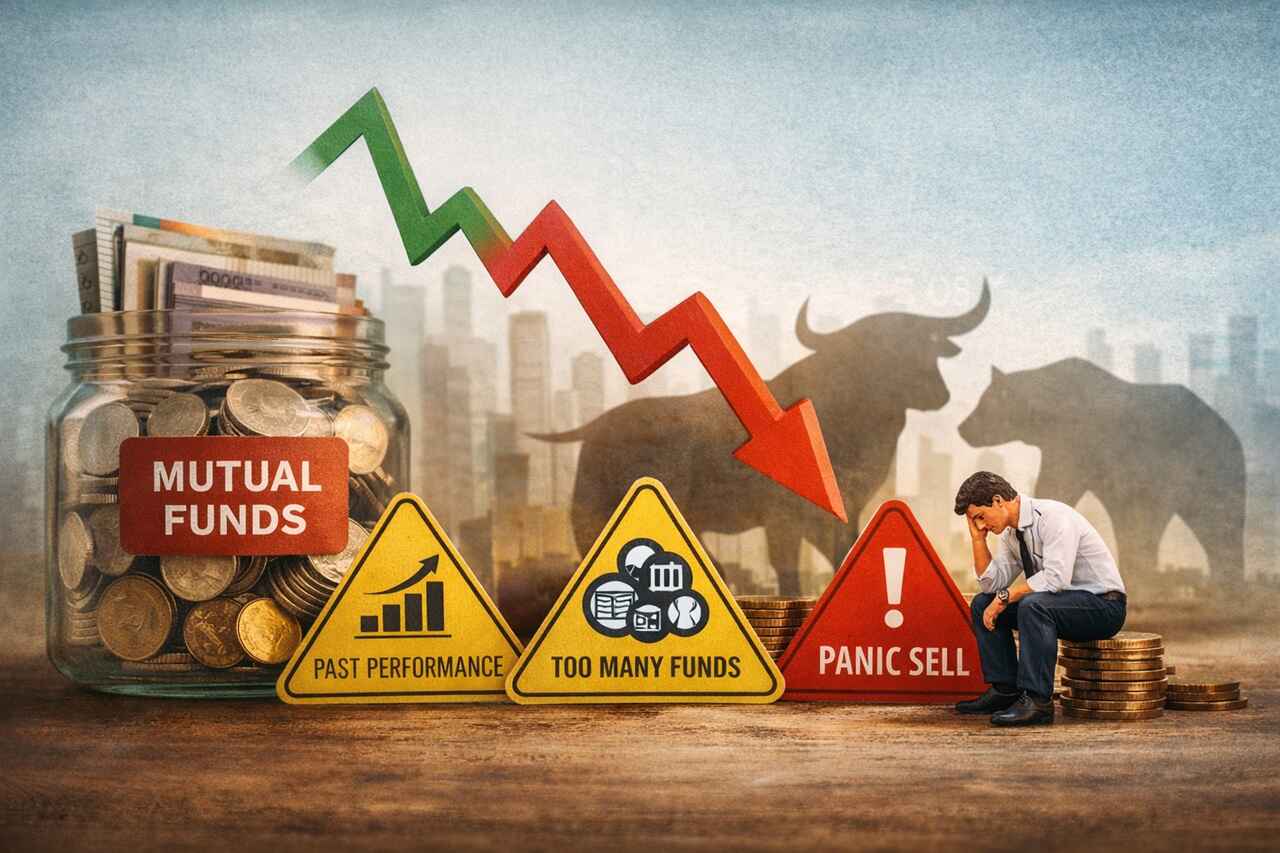
Markets change. Headlines change. Fund rankings change. But investor behaviour? It repeats almost every cycle. Over the last several market phases — bull runs, corrections, crashes, recoveries — I keep seeing the same three mutual fund portfolio mistakes repeated again and again. Surprisingly, these mistakes are not made by beginners alone. Even experienced investors fall into these traps. If you are investing through SIPs or lump sum in mutual funds, this article may help you correct small mistakes that could significantly improve your long-term returns.
Let us look at the three most common portfolio mistakes I see in every market cycle.
Mistake #1: Chasing Last Year’s Top Performing Funds
This is the most common mistake.
An investor checks 1-year returns. Sees a fund delivering 35–40%. Immediately invests.
But here is the problem — markets move in cycles. Categories lead in phases.
- 2017–18: Mid & Small caps outperformed sharply
- 2020–21: Flexi-cap and growth funds dominated
- 2022: Value and large caps performed better
- 2023–24: The leadership rotated again
Top performers rarely stay on top for 3–4 consecutive years.
Why This Hurts Returns
When you invest after strong performance, valuations are often already expensive. Future returns moderate. You enter at peak optimism.
Over time, this creates a pattern of:
- Buying high
- Switching frequently
- Lower actual portfolio returns compared to fund returns
What You Should Check Instead
Instead of 1-year returns, look at:
- 5-year rolling returns
- Downside protection during corrections
- Consistency across market cycles
- Portfolio allocation strategy
Mistake #2: Over-Diversification (Owning Too Many Funds)
Many investors proudly say: “I have 14 mutual funds.”
But when I analyse such portfolios, I often see heavy overlap.
Example structure I commonly see:
- 3 Large Cap Funds
- 2 Flexi Cap Funds
- 2 Multicap Funds
- 3 Midcap Funds
- 2 ELSS Funds
When we check underlying holdings, the top 20 stocks are almost identical.
This is not diversification. This is duplication.
Why Over-Diversification Reduces Returns
- High overlap reduces alpha potential
- Hard to track performance
- SIPs spread too thin
- Portfolio behaves like an index but with higher expense ratio
Ideal Number of Funds (Practical Framework)
For most retail investors:
- ₹1–5 Lakhs portfolio: 2–3 funds
- ₹5–25 Lakhs portfolio: 3–5 funds
- ₹25 Lakhs+ portfolio: 4–6 funds
Beyond that, complexity increases without meaningful benefit.
Mistake #3: Panic Exit During Market Corrections
Every correction feels different when you are inside it.
When markets fall 15–20%, headlines become negative. Investors stop SIPs. Some redeem fully.
But data shows a different story.
- 2008 crash: Market recovered strongly in following years
- 2020 pandemic fall: One of the fastest recoveries in history
- 2022 correction: Stabilised and resumed growth
Long-term wealth is created by staying invested during volatility.
The Real Risk
Volatility is temporary.
Permanent capital loss usually comes from emotional decisions.
Stopping SIPs during corrections often means missing lower NAV accumulation.
Why These Mistakes Repeat Every Cycle
Because investing is more psychological than mathematical.
- Recency bias makes us chase winners
- Fear makes us exit during falls
- Overconfidence makes us over-diversify
Every cycle feels new. But investor behaviour remains predictable.
Simple 3-Step Portfolio Correction Checklist
You can review your portfolio in 30 minutes using this checklist:
- Do I own more than 5–6 funds without clear allocation purpose?
- Did I invest based only on recent 1-year returns?
- Did I stop or reduce SIPs during corrections?
If answer is “Yes” to any of these, small course correction may improve long-term results.
Final Thoughts
You don’t need extraordinary intelligence to succeed in mutual fund investing.
You need discipline.
Avoid these three mistakes consistently across market cycles and your returns may improve automatically — without chasing new funds every year.
Markets will continue to change.
Your behaviour should not.

- Top 5 Small Cap Mutual Funds in 2026 Based on Rolling Returns (High Risk High Return) - April 2, 2026
- Capri Global Capital NCD – April 2026 – Issue Details, Interest Rates, Ratings and Review - April 1, 2026
- Protecting Your Pockets – How Comprehensive Plans Cover More Than Just Basic Repairs? - March 31, 2026